
VPO & Performance and Governance
Many companies know where they want to go.
Few have the management structure required to get there.
Verdius helps infrastructure companies turn growth into performance, governance and value creation

Value Performance Office — VPO
From strategy to performance: an integrated management system designed to create sustainable value.
The VPO translates strategy into a structured execution model through seven integrated stages:
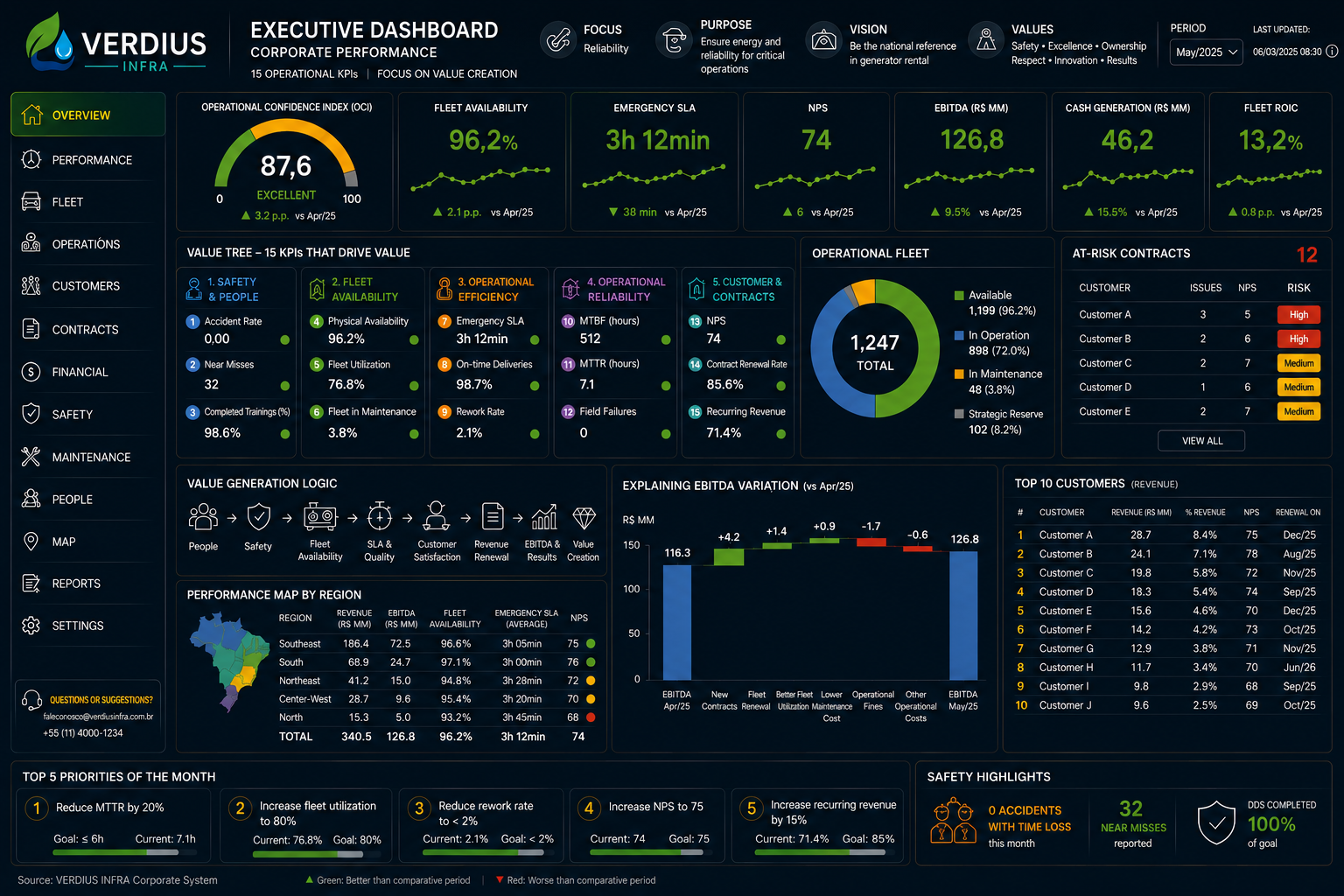
Executive Diagnosis → Value Driver Tree → Key Performance Indicators → Executive Dashboard → Management Rituals → Action Plan → Leadership Enablement
Growing isn't enough. Verdius integrates strategy, indicators, leadership and governance into management systems built to sustain new growth cycles.
The Sustainable Value Creation Journey
More than a performance management model, VPO establishes the discipline required to connect strategic priorities, executive decision-making and operational execution.
The goal is not to create dependence on consulting support, but to implement a management system that can be embedded, led and sustained by the organization itself.

Growth Is Not Enough.
Verdius integrates strategy, performance indicators, leadership and governance into management systems capable of sustaining new cycles of growth.
Why This Matters
The infrastructure sector is going through an intense cycle of expansion, with new contracts, increasingly complex portfolios and geographically distributed operations — yet many management models remain anchored in outdated practices.
This disconnect leads to efficiency losses, weaker controls and greater difficulty in capturing the full value potential of infrastructure assets.
Aligning performance, governance and value creation means treating all three as a single management system — translating strategy into clear indicators, achievable targets and disciplined management routines that connect the Board, executive leadership and operations.
Most common symptoms
- Indicators disconnected from strategy — the team tracks operational numbers unrelated to strategic priorities.
- Excessive dependence on key people — decisions concentrated in a few executives make operations fragile.
- Difficulty scaling — every new contract requires disproportionate coordination effort.
- Low integration between areas — engineering, operations, finance and legal work in silos.
- Productivity loss — energy spent on operational tasks instead of continuous improvement.
- Slow decisions — long approval flows delay investments and scope changes.
- Growth without proportional value generation — revenue grows, but profit, cash and returns don't keep up.
Success story
In a Value Performance Office (VPO) Program implemented for a large water and sanitation concession operator, instead of proposing a new BI system, we plugged into the decision-making routine the sanitation utility already had.
In 90 days, we defined a Value Tree with a few priority indicators, deployed an executive dashboard, and joined the company's existing monthly performance meetings.
By the end, the methodology was fully handed over to the internal team.
Aligning performance and governance reduces dependence on key people, standardizes critical routines and increases the predictability of results — raising productivity, scalability and value for shareholders and stakeholders.